AI-Powered Analytics Platform
Industry: IT and Software Development
Services: AI Transformation, Process Automation (IPA), Enterprise Orchestration
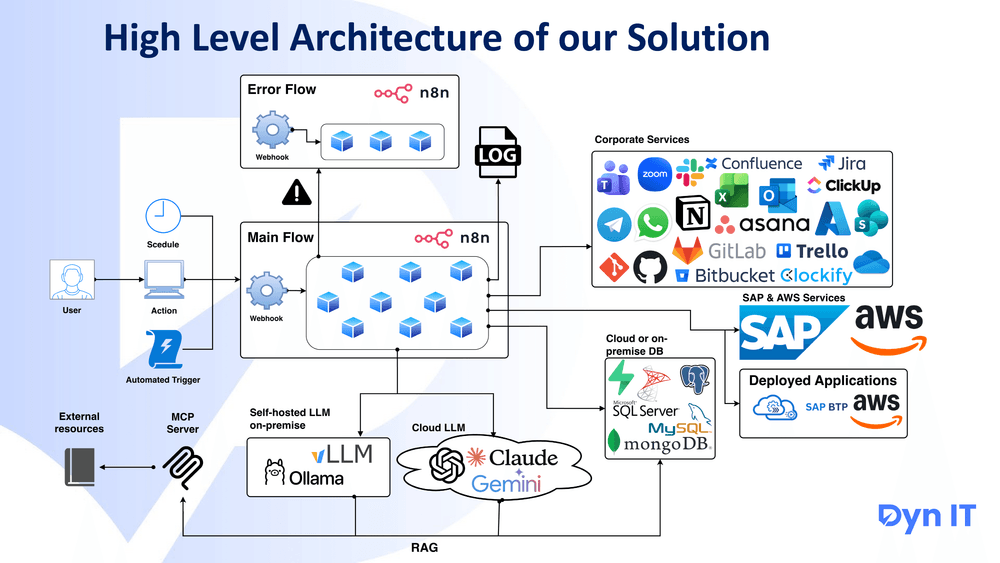
Tech Stack: n8n, RAG, LLM (OpenAI/Anthropic), Vector Databases, MCP
Project Overview
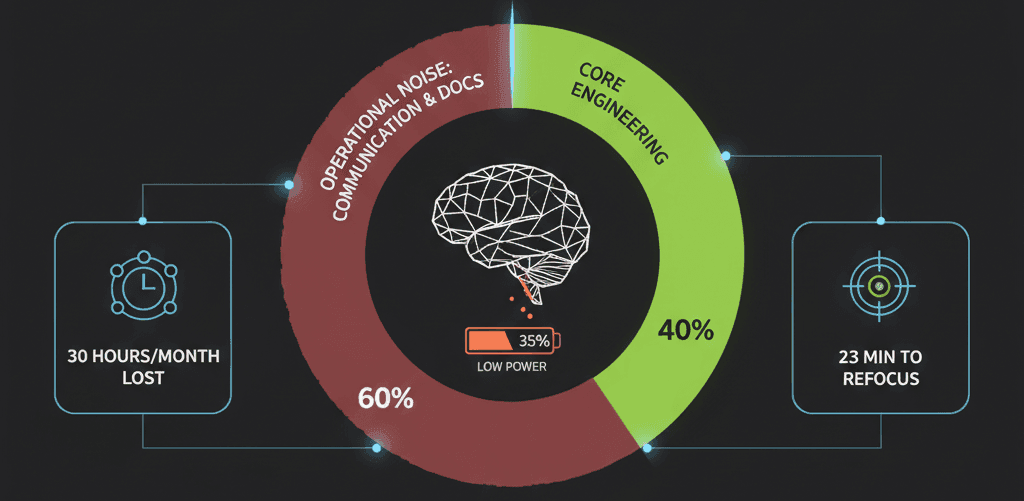
Project analysis showed that up to 60% of developers' working time was spent on operational routine. Most of the day, specialists worked not with code or architecture, but with information: searching for solutions from past discussions in Slack, matching tasks in Jira with documentation in Confluence, and manually synchronizing changes between teams.
Constant context switching between systems led to slower development and errors at the interfaces between teams.
Business Challenge
The main goal of the project was to free up highly qualified resources by automating low-value tasks.
Key Pain Points:
-
Information Chaos: Data is distributed across Jira, Confluence, GitHub, and Slack without a single access window.
-
Focus Recovery Gap: After each interruption for a routine request, a developer needs up to 23 minutes to return to deep work.
-
Traditional Barriers: High costs and long development times of classical scripted integrations.
Implemented Solution
We moved away from the concept of linear automation in favor of adaptive AI agents. The solution is based on the n8n platform, serving as the "digital nervous system" of the enterprise.
1. Intelligent RAG-based Search
Instead of classical search queries, Retrieval-Augmented Generation technology was implemented. AI agents query the corporate knowledge base in real time, providing engineers with accurate answers with references to documentation or code, eliminating model hallucinations.
2. SDLC Optimization
-
Intelligent Code Review: Automatic pre-review of pull requests with analysis for compliance with internal security standards.
-
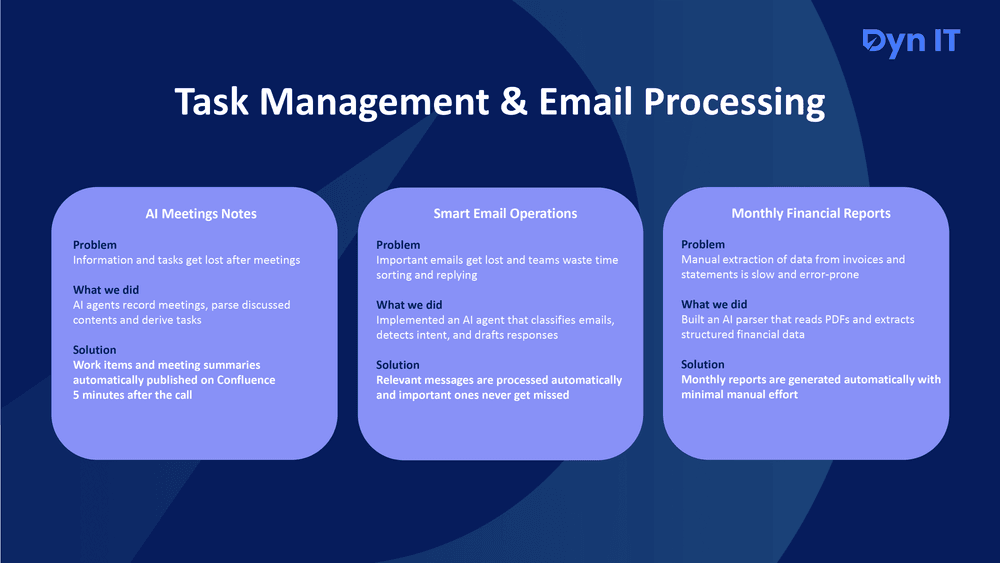
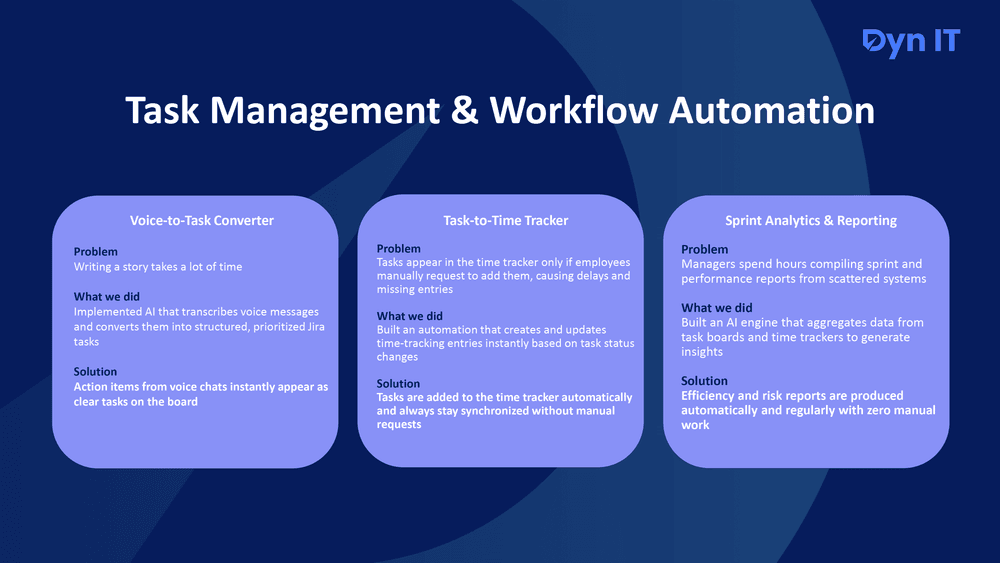
Voice-to-Task Engine: Instant transformation of voice notes from meetings into structured Jira tickets with filled acceptance criteria (AC).
-
Automated Definition of Ready: AI validator checks task completeness before sprint planning.
3. Back-Office and HR Automation
-
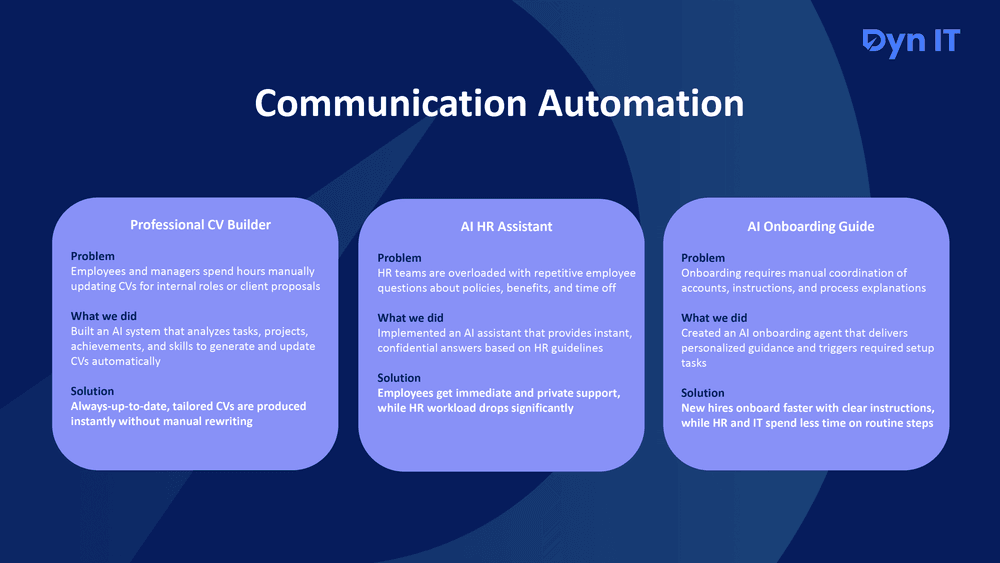
AI HR-Partner: Onboarding automation and instant answers to employee questions about corporate policies.
-
Smart Mailroom: Incoming request classification system and automatic generation of contextual draft responses.
Measurable Results
We implemented a tool that consolidated engineering context in one place and automated key synchronization points. Within the first months, the team noted fewer repetitive questions, faster decision-making, and increased focus of senior specialists on high-value tasks.
Orchestration platform deployment enabled operational processes to run on "autopilot":
-
+30 hours per month: Additional time for pure development per engineer.
-
Time-to-Market: Reduction of new integration and automation deployment from months to 2–3 weeks.
-
Self-Healing Architecture: Reduced maintenance costs thanks to workflow self-healing mechanisms (retry logic and error handling in n8n).
-
Data Sovereignty: On-Premise deployment option ensures enterprise-level data security.
Technology Architecture
-
Core Orchestration: n8n (Self-hosted), MCP servers
-
Artificial Intelligence: OpenAI GPT-4o, Anthropic Claude 3.5 Sonnet, local models via Ollama
-
Knowledge Management: Vector DB (Pinecone/Weaviate), RAG pipelines
-
Ecosystem Integrations: Jira, Confluence, GitHub, Slack, PostgreSQL